
Behind the Scenes: How We Built the eazyBI Assistants
In the last couple of years, AI has gone from a buzzword to something real we can work with. It started with curiosity. Then came the experiments. And then the questions: Could we bring AI into eazyBI in a meaningful way? Could it become a helpful part of the product – not a flashy extra, but something that actually makes life easier?
During eazyBI Community Days 2025, Gerda from the eazyBI support team shared the eazyBI journey with AI assistants.
It Started with Curiosity (and a Bit of Skepticism)
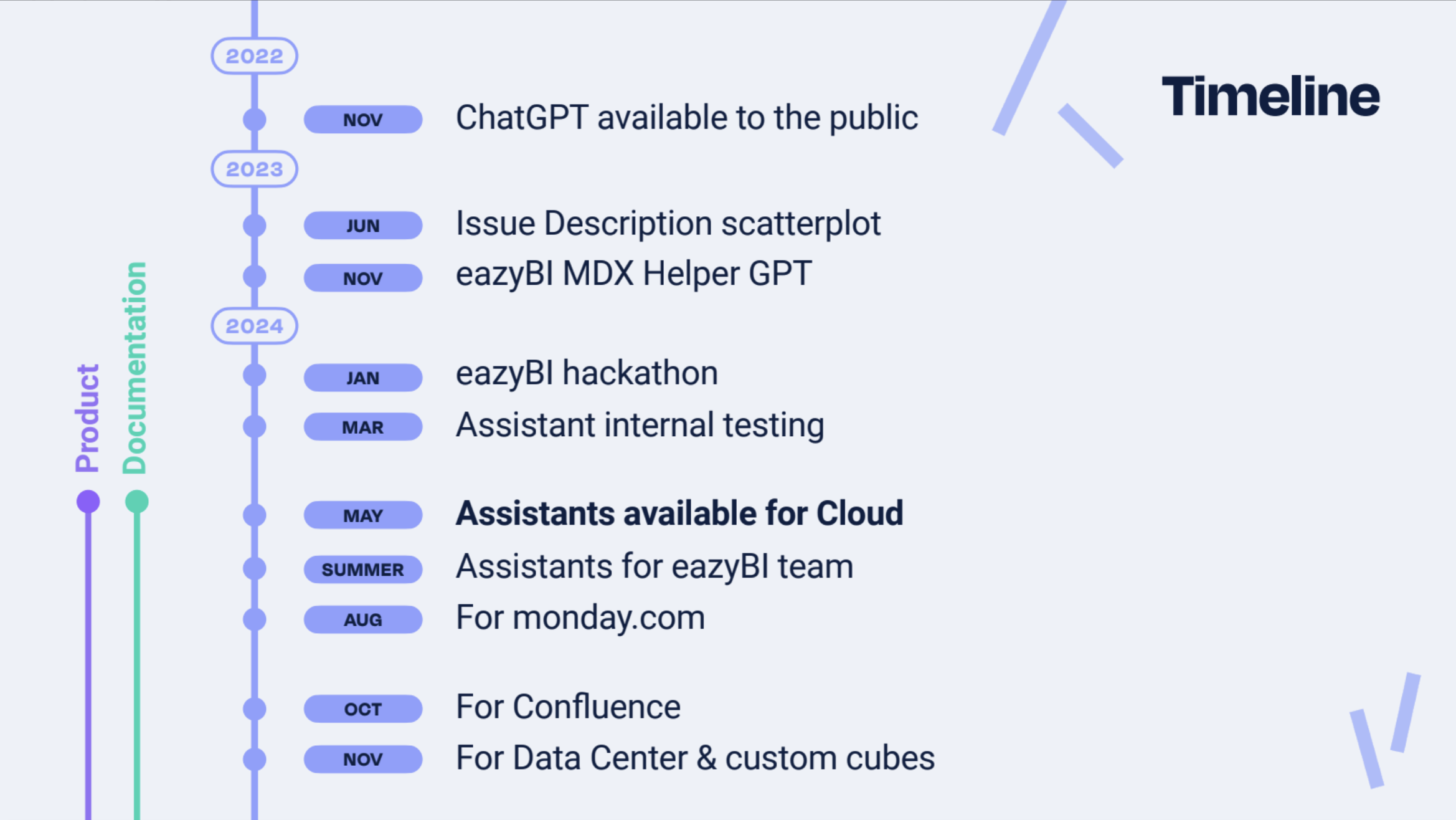
When ChatGPT first launched in late 2022, we were skeptical – like many others. Would it last? Was it another tech trend that would fizzle out?
In the eazyBI team, there were cautious observers… and there were pioneers. Jānis Vanags was one of the first to explore how AI could be used alongside eazyBI. He shared experiments using Midjourney and GPT, including one idea that turned Jira issue descriptions into embeddings for a scatterplot visualization in eazyBI.
That idea made it to GitHub – but we weren’t quite there yet.
Other team members played with custom GPTs, trained with eazyBI documentation and use cases. Interesting results, but still not enough. We wanted something more structured, more controlled, and – most importantly – integrated directly into eazyBI.
Building the First eazyBI Assistants
In early 2024, during one of our regular in-person hackathons (we’re a fully remote company, but we like to meet up now and then), we began building what would become the eazyBI Assistants.
By March, the first versions were ready for internal testing. As always, our support team tried hard to break them – and found plenty of ways to improve the assistants.
In May 2024, the Assistants were released to all eazyBI Cloud users. A time of learning and iteration had paid off.
What Can the Assistants Do?
Today, there are five eazyBI Assistants available in the Cloud version:
- Report Builder Assistant – for building simple reports and explaining what measures or filters do.
- MDX Formula Assistant – for writing and debugging custom calculations in MDX.
- JavaScript Custom Field Assistant – for writing JavaScript for advanced custom field logic (a favorite for those who know what they want from Jira, but aren’t fluent in JS).
- Conditional Formatting Assistant – for setting up conditional formatting for your reports (tables and charts).
- Report Optimizer Assistant – helps you improve and speed up existing reports.
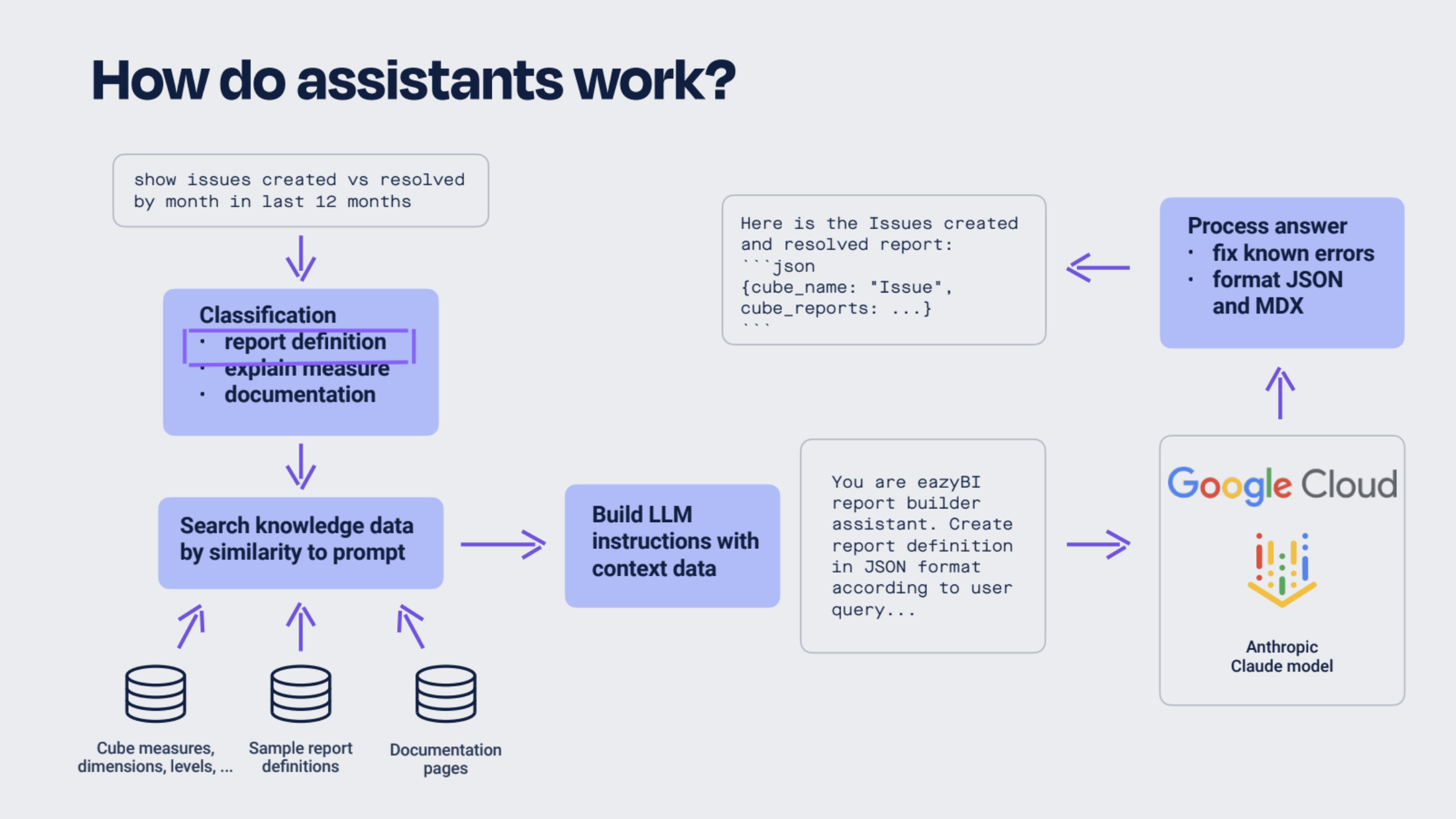
Each assistant uses structured eazyBI metadata (like dimensions and measures), public eazyBI documentation, and curated sample reports as its source of knowledge. When a user types a prompt, the assistant searches this structured knowledge, builds a custom instruction, and then sends that to a large language model (LLM) hosted in Google Cloud. After processing the result, it returns an answer inside eazyBI.
Behind the scenes, there’s a lot of filtering and error handling going on, but for the user, the experience should feel simple and helpful.
How AI Assistants Changed eazyBI
Working with the assistants also pushed us to improve our documentation and even some product features. Here are some of the examples that we improved:
- We split long documentation pages into smaller, more focused ones (easier for the assistant and for you).
- We added missing topics like issue links and tuple examples, based on real assistant misunderstandings.
- We added predefined measures (like issue summaries) to replace overly complex MDX solutions that the assistant had been suggesting.
- We reviewed performance tuning examples to make them more accessible to the assistant and to users.
- We made hidden dimensions like Worklog visible, so users and assistants could use them more effectively.
In other words, the assistant didn’t just make the product more helpful – it also helped us improve the product.
Lessons Learned Along the Way
- Small changes matter – updating just one instruction, example, or documentation tag can dramatically improve the assistant’s responses, and it impacts the report quality of dozens of customers.
- Assistants reflect what you give them – they know what you teach them. Nothing more, nothing less. We at eazyBI are still responsible for the AI Assistant answers.
- Customer interactions are the best feedback loop – real prompts, real misunderstandings, and real conversations help us make real improvements.
- Pattern-based learning works – assistants respond better when your documentation includes relevant examples, clear headings, and consistent tagging.
- They still make mistakes – sometimes confidently. Always double-check their answers.
- They can’t read your mind – you need to be specific in your prompts. The clearer you are, the better the answer. Though you can use your native language.
And yes, our human support team is still smarter. 😉
What Comes Next?
Initially launched Assistants on eazyBI for Jira Cloud, were expanded to our other products – eazyBI for Jira Data Center, eazyBI for Confluence Cloud and Data Center, eazyBI for monday, Private eazyBI, and eazyBI Cloud. We’ve also built internal assistants to help with support conversations, spam detection, and more. And now we also have a general AI Assistant in eazyBI Home page to answer all types of questions related to the tool.
As we continue to learn, we continue to refine – instructions, documentation, product behavior - but one thing hasn’t changed: assistants are still a work in progress.
We’ve seen what happens when curiosity meets persistence. You don’t need a perfect idea to start. You just need to experiment, improve, and stay open to change.
Whether you're building assistants, learning to prompt better, or simply exploring new tools: Play. Learn. Improve. And don’t be afraid to change things when something better comes along.
 Total number of AI conversations until January 2026
Watch the full presentation video recording here.